
Stage 5 - Sometimes the strongest rider is enough.
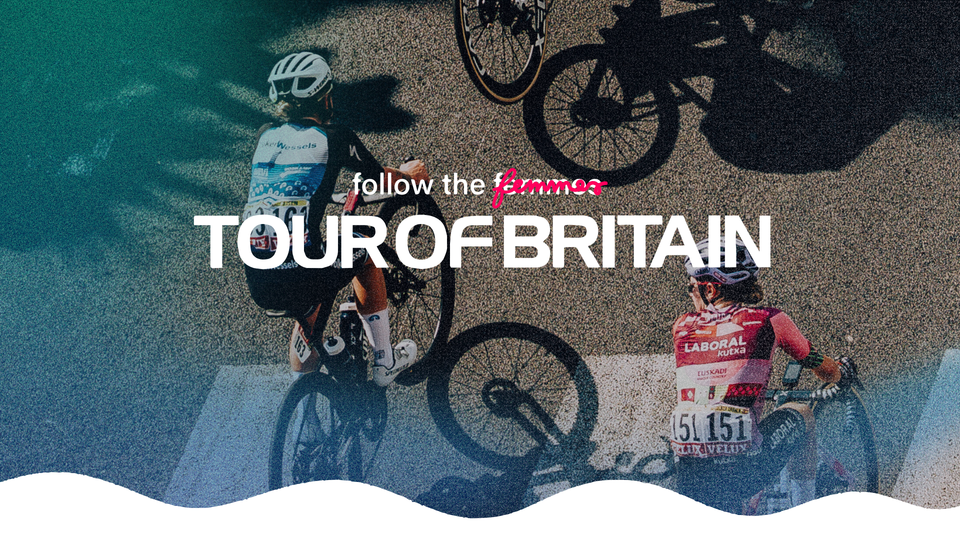
The final stage of the Lloyds Tour of Britain Women was, on paper, the simplest of the week.
At a little over 120kms with around 1,350 metres of climbing, it was comfortably the flattest stage of the race. There was one intermediate sprint and two QOMs, both coming inside the final 40kms.
But with Kim Le Court-Pienaar leading the GC and plenty of teams still looking for something from their week, there was always potential for an aggressive final day.
And initially, that's exactly what we got.
Nothing to lose, everything to gain
The final day of a stage race is often an opportunity for teams whose week hasn't gone entirely to plan.
There's no tomorrow to save your legs for. If you don't have a sprinter capable of winning from the bunch and you're no longer fighting for the GC, you might as well put yourself out there.
FDJ-SUEZ did exactly that.
They came to this race with a strong but relatively inexperienced team, including Lauren Dickson and Kate Courtney.
Lauren has made enormous progress in a short space of time. She had a breakthrough last season before joining FDJ-SUEZ, and we've already seen her become an important support rider for Demi Vollering. This was also her first race back after breaking her collarbone at the Tour de Suisse.
She certainly didn't have an easy return.
There were crashes throughout the week, including twice yesterday, but she kept fighting and will leave the Tour of Britain with the QOM jersey. For a rider still gaining experience at this level, that's an important result.
Kate Courtney is at an even earlier point in her road journey. Coming across from an incredibly successful mountain-bike career, this was her first World Tour stage race, and we've already seen glimpses of what she could become on the road — including an impressive 4th place yesterday.
FDJ hadn't necessarily collected the stage results they might have hoped for, though, so today they had every reason to attack.
Eva van Agt makes the race
Around 10kms into the stage, Eva van Agt went clear.
She was soon joined by Movistar's Sara Martín and Alice Towers, racing here for the British national team.
This was a strong breakaway, but Eva was by far the most dangerous rider overall. She started the day much closer on GC than her two companions, and that dictated how the breakaway was ridden.
Eva had the most to gain.
And she rode like it.
She was consistently one of the strongest engines in the move, driving the pace and helping the advantage grow to the point where she became the virtual leader on the road.
Suddenly, AG Insurance-Soudal had a problem to solve.
The responsibility of the leader's jersey
Once again, AG Insurance-Soudal responded exactly as the leader's team needed to.
That's something we've seen since Kim took the leader's jersey on Stage 3. They came to this race with a clear leader, and once Kim took green, the entire team committed to defending it.
Today was another good example.
When Eva's advantage became dangerous, AG didn't wait for somebody else to solve the problem. They brought the team to the front, took responsibility and steadily brought the situation back under control.
Importantly, they also didn't panic and close the gap unnecessarily early. They kept the breakaway within a manageable distance while preserving as many resources as possible for the harder part of the stage.
As the peloton approached the two QOMs inside the final 40 kilometres, the race naturally became more selective. That's where Kim eventually found herself without teammates around her.
But by then, AG had already done an important part of their job: the breakaway had been contained and Kim was still in control of the overall race.
From there, it became a question of what the other GC teams would do.
The move I expected from Movistar
Sara Martín's presence at the front was particularly interesting.
She's a strong rider and having her in the breakaway gave Movistar a potential satellite rider for Liane Lippert.
With Liane sitting close to Kim on GC and the hardest climb of the day still ahead, the ingredients were there for Movistar to try something.
The gap was significant (around two minutes) so bridging across wasn't going to be easy.
But this was the final day.
There was nothing left to save.
I expected at least an attempt from Liane on one of the QOM climbs: make Kim respond, try to create separation and, if she could get clear, have Sara waiting ahead to help.
Instead, Movistar remained relatively conservative.
And that became one of the defining tactical stories of the stage for me.
Josie Nelson gives it a go
Someone who was willing to gamble was Josie Nelson from Picnic PostNL.
On the hardest QOM of the day, her team really drove the pace, with Josie herself contributing to making the climb difficult.
That stood out.
We generally think of Josie as more of a sprinter, yet here she was pushing the pace on a climb averaging around nine percent.
Why?
Because Lorena Wiebes was still there.
If you're a fast finisher and you want to win a stage containing Lorena, your best opportunity probably isn't waiting until 200 metres to go and trying to outsprint the world's fastest sprinter.
You need to remove her before the sprint happens.
It didn't work, but I loved the intent.
They were willing to try to change the race rather than simply accept the most likely outcome.
Kim stays in control
On the second QOM, we saw Kim taking responsibility herself.
She was isolated by this point and moved towards the front, controlling the pace and making sure she could respond immediately if one of her GC rivals tried something.
You could sense the concentration. This was the final stage, the hardest part of the course, and the moment when the overall race was potentially most vulnerable.
But Kim never allowed herself to be caught out.
That's one of her great strengths as a racer. She's incredibly good at reading situations and understanding which moves actually require a response.
And once the second QOM was behind them and groups began coming back together, the tactical situation started moving increasingly in her favour.
Who should chase?
This is where today's race became most interesting to me.
SD Worx-Protime had an obvious reason to work.
Lorena Wiebes was still there. They had the fastest finisher in the race and a very realistic chance of another stage victory, as well as an opportunity to improve Lorena's GC position.
So of course they chased.
What surprised me was how many other teams were willing to help them.
Human Powered Health contributed. Canyon//SRAM contributed. UAE Team L'Imad contributed.
And tactically, I found that fascinating.
Every kilometre those teams spent helping close the breakaway was a kilometre of work that neither AG Insurance nor SD Worx had to do.
For AG Insurance-Soudal, it was almost the perfect scenario.
Kim was the race leader and had been isolated when the terrain became difficult, yet rival teams effectively helped stabilise the race around her.
For SD Worx, it was pretty good too.
They had Lorena Wiebes waiting for the sprint.
Risk versus reward
This is one of the dynamics I find particularly interesting in racing.
There are two ways of looking at a situation like today's.
You can protect the GC position you already have and chase because you want the best possible stage result.
Or you can gamble.
If I were looking at it purely from the perspective of a team trying to take the overall victory away from Kim, I would have wanted to make AG Insurance-Soudal do as much work as possible first.
They had the jersey, so make them spend their resources.
If AG couldn't close it, then SD Worx had an obvious incentive to contribute because they had Lorena waiting for the sprint.
And only once the break was within striking distance would I want to start playing another card — particularly if I were Movistar with Sara already ahead and numbers still available behind.
Attack. Counterattack. Force Kim to make decisions herself.
Maybe it works.
Maybe you lose the position you already have.
That's the gamble.
And I think that's the broader tactical lesson from today.
Sometimes teams race to maximise the position they are likely to achieve rather than risk that position for the possibility of something bigger.
That's not necessarily wrong. UCI points matter. Results matter. Contracts matter.
But it can also make life considerably easier for the strongest rider.
And if you bring Lorena to the sprint...
We know how this story ends.
After everything that happened during the stage, the breakaway was eventually caught and Lorena Wiebes did what Lorena Wiebes does.
She won...again.
Four victories from five stages is an extraordinary return.
She also collected enough time to move into second overall, pushing Liane Lippert down a position on the final GC.
And that makes the tactical choices of the final kilometres even more interesting in hindsight.
The teams helped bring the race to the scenario that most favoured SD Worx-Protime.
And SD Worx took full advantage.
The strongest rider - and the smartest race
So perhaps my biggest takeaway from this year's Tour of Britain is that winning a stage race isn't always about having the strongest team numerically in every decisive moment.
It's about knowing your objective and using the resources you have effectively.
AG Insurance-Soudal came here with a clear leader and committed to Kim throughout the week. They helped her collect opportunities, controlled when the responsibility was theirs, and when the racing became selective and Kim had to take responsibility herself, she had the strength and intelligence to do it.
That's a successful team performance.
Could the other teams have raced more aggressively against them on the final stage? Tactically, I think so.
Would it have changed the outcome?
We'll never know.
That's cycling.
What we do know is that Kim identified the stage where she could make the difference, took her opportunity, and then she and AG Insurance-Soudal successfully managed the race from there.
Lorena Wiebes leaves with an extraordinary four stage victories and second overall. Liane Lippert and Movistar were consistently among the strongest challengers. Lauren Dickson takes the QOM jersey, while Fleur Moors leaves with the young rider classification after another week that showed just how exciting the next generation is.
Five stages showed five very different versions of bike racing: crosswinds, rain, breakaways, crashes, uphill attacks, tactical battles and dominant sprints.
And that's exactly why we keep following the femmes.
— Ashleigh
Member discussion